
Jasmine presented her Master’s project at the EPS conference
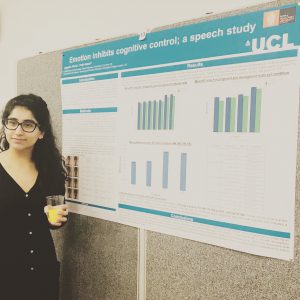
Cognitive control, more specifically conflict processing abilities, are integral to daily human life. This study aimed to explore the relationship between the perception of emotional facial expressions and production of emotional speech sounds, through investigating how emotion influences conflict resolution. In an adapted version of Zinchenko et al.’s (2015) study, using visual stimuli only, participants were required to respond vocally to written prompts (task relevant stimuli) appearing over the mouth of a speaker in a video (task irrelevant stimuli). The study comprised of four conditions; neutral target- neutral distractor, neutral target-emotional distractor, emotional target-neutral distractor and emotional target-emotional distractor. The results show an overall stimulus response compatibility (SRC) effect for each condition. Overall response times were greatest when both prompt and distractor were emotional and lowest when prompt and distractor were neutral. No significant differences were found in RT data between emotional expression to neutral distractor and neutral expression to emotional distractor or the baseline neutral-neutral condition. Stimuli appearing later in the time course of a trial were responded to faster than earlier ones, and the resultant main effect that attending to task-relevant stimuli where emotional responses were required decreases cognitive control resulting in a larger SRC effects.